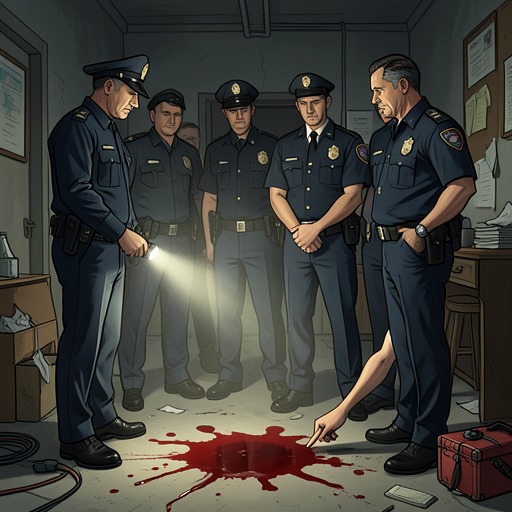
Clarence Duntz
In Cold BloodClarence Duntz is a Kansas Bureau of Investigation agent whose work on the Clutter case spans its early canvass and the later questioning of Perry Smith. He helps pursue leads across the countryside, travels with the investigative team to Las Vegas, and takes an active role in Dewey’s interrogation of Smith. The narrative presents him less through a private history than through the practical sequence of investigation: gathering information, testing it, and bringing a suspect back to the facts of a particular night.
Identity and Assignment
Duntz is one of three Kansas Bureau of Investigation special agents assigned to the Clutter investigation alongside Harold Nye and Roy Church. As the investigation expanded, eighteen men worked on the case full time. Alvin Adams Dewey regarded the arrival of the three agents as the formation of a strong team, placing Duntz within the principal investigative group rather than at its margins.
His colleagues called him Old Man, a nickname the narrative regards as unfair because he was not yet fifty. It distinguishes him as a burly man with a broad face, but also notes that he moved with the spontaneous agility of a much lighter person. In the interrogation scenes, his speech is rendered as a slow, drawn-out cattle-country drawl. These details mark a contrast between his heavy build and quick movement, and between the unhurried cadence of his speech and the purposeful pace of the investigation.
Canvassing and the Early Lead
Duntz joined Church and Nye in crisscrossing the countryside to speak with people who might know something about the Clutter family or the crime. Their inquiries reached the Holcomb School, where Nancy Clutter and Kenyon Clutter had been high-achieving students; the River Valley Farm employees; the victims’ friends and neighbors; and relatives who had come for the funeral. The work required investigators to ask questions amid grief, while searching for information that could explain an apparently motiveless crime.
Duntz brought back a lead involving a father and son, identified in the account only as John Senior and John Junior. Their earlier business dealings with Herbert William Clutter had left the father resentful. On one occasion, the two men came to the Clutter home intending to confront him, but Clutter turned them away after objecting to their drinking. Duntz learned that the father had continued to express anger about the encounter, including to an acquaintance about a month before the murders. The lead supplied investigators with a possible grievance and a pair of people to examine, but the passage presents it as a promising lead, not as a solution to the case.
The Las Vegas Investigation
After the arrests, Duntz traveled to Las Vegas with Dewey and Church. The team’s journey was difficult: the three drove through bad weather and spent New Year’s Eve snowed in at a motel in Albuquerque before reaching the city. They joined Nye, who had flown ahead. At the Las Vegas City Jail, four Kansas investigators gathered for the first confrontation with the suspects. Duntz was assigned to work with Dewey on Perry Smith, while Nye and Church focused on Dick.
Nye’s first view of Smith came through a one-way observation window while Dewey and Duntz questioned him. The account describes the investigators as having spent three hours narrowing the interview from Smith’s wider life to the decisive weekend, November 14 to 15. Duntz’s role was not simply to hear Smith’s recollection: he participated in the methodical process of bringing the account to its crucial details and challenging evasions or gaps.
Interrogating Perry Smith
When Smith gave an incomplete answer about the motel where he had stayed, Dewey signaled that it was time for Duntz to correct his account. Duntz then told Smith that he was going to explain where Smith had really been and what he had been doing that Saturday night. The narrative makes this intervention a turning point in the questioning: the investigators move from eliciting Smith’s version to confronting him with the location and conduct they believe the evidence establishes.
Duntz also helped control the sequence of Smith’s account. When Smith jumped ahead while describing the preparations for the trip, Duntz stopped him and brought him back to the earlier departure from Olathe. Smith then recounted the drive to Emporia, where he and Dick bought rubber gloves and cord, and the later stop in Great Bend, where they bought tape. Duntz’s redirection keeps the interview chronological, recovering the steps through which the planned robbery and journey unfolded rather than allowing the account to skip over them.
During the later discussion of Smith’s boast that he had killed a man in Las Vegas, Duntz agreed that Smith had not committed that particular homicide. He had studied files on unsolved Las Vegas killings and knew the claim was false. This knowledge separates Smith’s earlier story from the evidence of the Clutter case: the boast had helped shape Dick’s view of Smith as a potential killer, but Duntz’s investigation of the records established that it was not proof of the alleged Las Vegas killing. Across these scenes, Duntz functions as a field investigator and disciplined interviewer, helping test claims against records and turn a broad, guarded narrative into a more exact account.